11. DURGA PUJA 2025
Doux Sourire
10/14/2025
The Long-Awaited Puja
As a captain’s wife, I rarely get the chance to spend my days in India. Most years just float away between voyages, new ports, and endless horizons. But this year felt different. After six long years, Smith and I finally found ourselves home, in Kolkata, just in the time for Durga Puja. The moment our tickets were booked, I could already feel the puja rhythm beating inside me.
We planned everything like two excited kids. “This year,” I told Smith, “We will start our pandal hopping right after Mahalaya!” Kolkata is huge, and with thousands of pandals scattered across the city, four days were never enough. So, we decided to begin early-to soak in every light, every beat of dhaak, every crowd, every idol.
A week before the festival, our little preparations began. We picked soft, breathable cotton clothes, knowing how hot and humid Kolkata gets during puja. Our matching crocs clogs were ready too-because every day, we would be walking nearly 20kms. I remember telling Smith ten days before puja, “We will eat this and that, wear this dress, do twinning every day!” I was bubbling with excitement like a child waiting for her favourite fair to begin-and he as always, smiled and joined me in my madness wholeheartedly.
The City Awakens
Kolkata had started preparing itself for Durga Puja a month before the actual days. Every day on our way to MMA class, Smith and I would notice something new-roads wrapped in strings of lights, giant hoardings announcing sponsors of upcoming pandals, and traffic that somehow felt livelier, more impatient, more human. The city was slowly dressing up for her biggest celebration.
During our evening walks through New Town, I began to notice the Kaash Phool swaying gently along the roadside. After years, that sight felt like whisper from my childhood-those feathery blooms that always signalled Maa Durga’s arrival. Just one glance, and in my heart, her face appeared-radiant, fierce, motherly. It felt magical, almost nostalgic to the point of tears.
And then came the Sheuli flower-tiny, white, and fragrant-blooming quietly in our garden every morning. Their scent filled the air, a scent that only belong to this time of the year. For six years, I had been away during Puja-sailing to new countries, docking at new ports, tasting foods I could not even pronounce-and I was always content, grateful for that life. I never truly missed Puja or wished to be home during those days. But this year, something shifted. Watch Kaash dance in the wind and smelling Sheuli in the early morning air-it stirred something deep inside me. A feeling I could not name. a happiness so pure, it almost hurt.
Mahalaya Morning
Mahalaya morning arrived softly, like a whisper from the past. Around 5o’clock, when the sky was still painted in a sleepy blue, I woke up to a familiar sound floating through the window-Mahalaya playing from a loudspeaker in our para. Half-awake, half-dreaming, I sat up and just listened. The deep, echoing voice reciting the story of Maa Durga’s arrival filled the air, and something inside me melted.
It was the same sound that used to wake me up as a child-the unmistakable signal that Puja had begun. I could almost see my younger self again, sitting on the floor in front of the old TV, beside my little brother, with Maa and Baba sipping morning tea behind us. We would all watch Mahalaya together on Doordarshan, wide-eyed, excited, ready for the coming days of celebration.
That morning in Kolkata, after so many years, I felt the same innocent joy again. The smell of dawn, the faint chill in the air, the chants of Chandi Path-it all felt like a bridge between my childhood and now. Mahalaya was not just being played outside, it was echoing inside me.
When The City Cried
But just a day after that beautiful Mahalaya morning, the sky changed its mood. On the 22nd of September, Kolkata was drenched in endless rain-heavy, merciless, and unending. By the next day, the entire city was flooded. Streets disappeared under water, pandals that were almost ready stood half-drowned, their colourful fabric sagging with rain. The sound of thunder replaced the rhythm of dhaak.
It was not just me-it felt as if the whole Kolkata was crying. Everyone had waited so eagerly for this Puja, but the rain washed away our excitement like wet chalk on a board. The pandal inaugurations were postponed, artists were heartbroken seeing their months of labour damaged, and for a moment, it felt as if our Puja had been ruined even before it began.
But Kolkata has a way of finding light even in the darkest clouds. After three long days, the rain finally stopped. The sun came out again on the 25th of September, spreading warmth and hope over the soaked city. Workers rushed to repair, repaint, and rebuild what the rain had taken away. And that day, one by one, the pandals finally opened-shining even brighter after surviving the storm.
The First Day of Pandal Hopping
Chaturthi evening, Smith and I were finally ready. I wore a delicate schiffli work baby pink shirt with black jeans, and he looked effortlessly charming in his white cotton shirt with little spaceship prints and black linen pants. Of course, our trusty crocs clogs completed the look-because we knew we would be walking endlessly.
Our first stop was Lake Town, just a short distance from our home. The overhyped Shreebhumi Pandal was our first encounter-a grand replica of the Swaminarayan Mandir of New Jersey. The idol, as always was reminiscent of 2019, but the crowd-oh, the crowd! Pushed and jostled through the sea of people, I realized something important: next year, we are skipping Shreebhumi. 30mins of struggle for something overhyped is not worth it, when there is so much more to see.
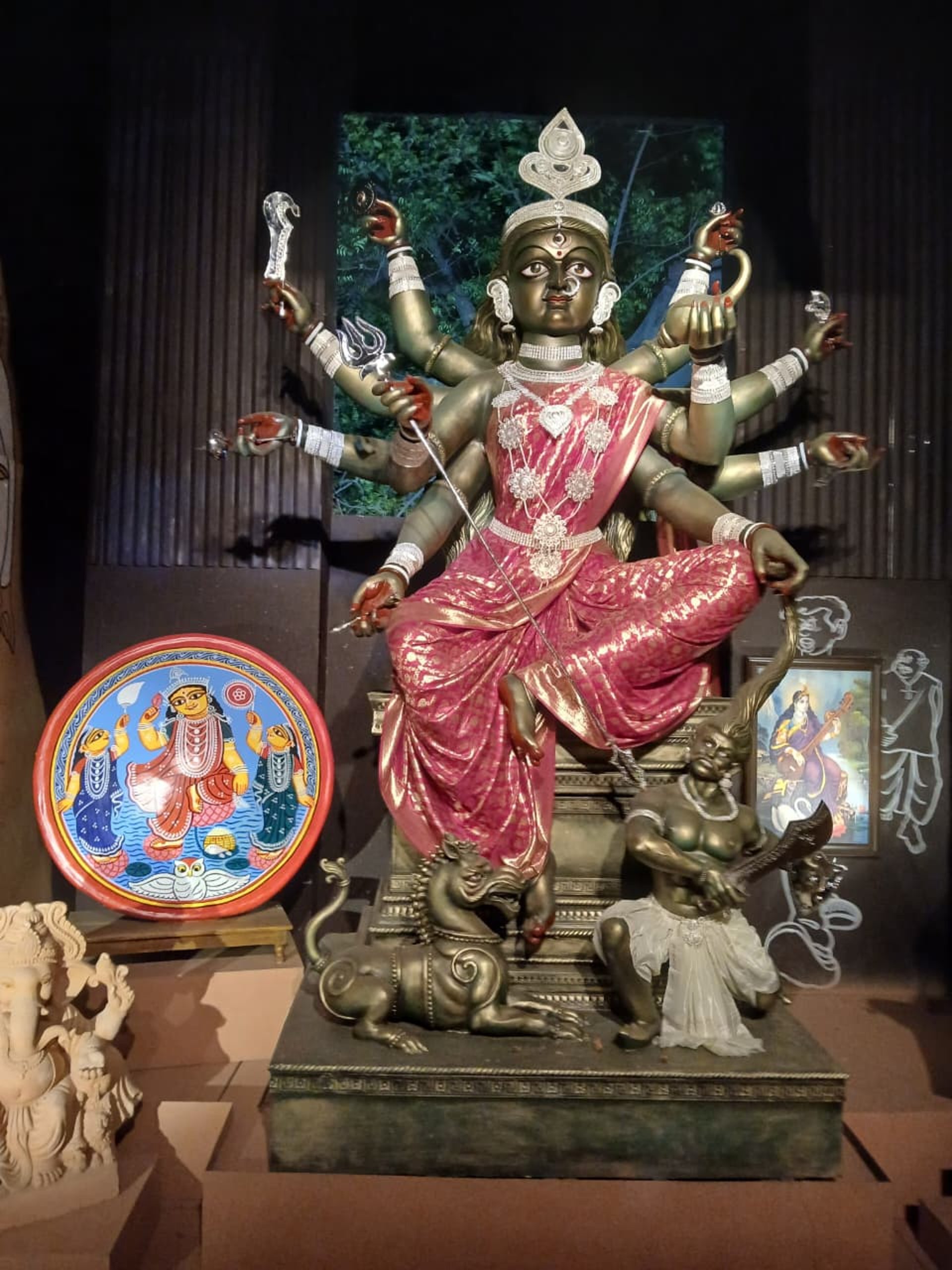
We moved to Dakhindari Club. The theme this year was women empowerment, and the Pandal was breathtaking. Every sculpture, every detail, every curve of the idol exuded strength and motherly warmth. Watching it, I felt an overwhelming mix of admiration of serenity. This-this felt like Puja.
Then we strolled through Lake Town, visiting famous pandals like Tarun Dal, Bharat Chakra, and Yuvak Brinda Club. Each had its own charm, its own theme and each stole a little piece of my heart. But the real magic? Experiencing all of it with Smith. Hand in hand, walking through the streets, talking, snacking, munching, sipping tea. Love existed in the hot and humid air, tangled with the sound of dhaak and scent of street food.
By late night, we finally collapsed for dinner at Hatari Restaurant, devouring Chinese food like two exhausted pilgrims of joy. Back home, utterly drained, we fell asleep instantly-promising each other we could not possibly go out the next day. And yet, our hearts were still wandering the streets of Lake Town, dreaming of the pandals we would visit in the days ahead.
North Kolkata Magic
Panchami morning arrived with a soft rhythm of dhaak that somehow gave us energy, despite being tired from the previous day. By afternoon, we were ready to explore the heart of North Kolkata-the city’s ancient soul. I wore an indigo print top paired with beautiful Ajrakh flared skirt, and Smith, yes, I styled him too, in a pretty indigo print shirt with olive green linen pants. Crocs clogs of course, completed our explorer look.
North Kolkata is timeless-narrow lanes, centuries-old British houses, and over a hundred years rich, royal shabeki pujo. During Durga Puja, its essence becomes almost tangible. Our first stop was Tala Prottoy, whose theme this year was Seed. I had visited years ago, and yes, it was always magnificent, but nothing prepared me for this year.
We walked along a line stretching over one and a half kilometres. I had Googled the theme beforehand and was proudly explaining it to Smith, eager to show off how “smart and knowledgeable” I was. I whispered about the giant cauliflower at the entry and when we finally saw it from afar, I could not help but scream, “See! I told you!” Smith just smiled at me, and for a brief moment, I thought- maybe he really thinks I am clever.
Once inside, the pandal revealed a world beyond imagination. The area was massive, every corner utilized by the artist. Through the cauliflower gate, in the centre, a giant seed rested under a treehouse. From inside, five performers dressed as seed covers emerged, dancing to a carefully choreographed song. Everywhere I looked, performers appeared-some as caterpillars inside cocoons, others as fertilizers, others as chemical pesticides, showing how these forces impact organic life. The entire 10-minutes performance unfolded seamlessly, immersive, and alive.
And then, Maa Durga. Instead of her trishul, she held a plough, embodying the strength of a farmer. Her idol was immense, her eyes radiant, her hair perfectly tied so nothing could distract her from work. Every detail, every movement, every element of the pandal-the theme, the idols, the music, the performers-flowed together in flawless harmony. The 10 minutes passed in a blink, and we were outside. Silent, lost in the magic of what we had witnessed.
And in that moment, I realized-all Googling in the world could never have prepared me for this. It was bigger, more alive, and far more moving than any photograph, any description, any expectation could ever convey.
North Kolkata Lanes and Little Adventures
After Tala Prottoy, our stomachs reminded us that it was time for some snacks, so we indulged in puchka along way, letting tangy, spicy flavours recharge our energy. Then, we continued our pandal hopping across the historic heart of Kolkata- Tala Barwari, Kumortuli, Ahiritola, Shovabazar, Shyambazar, Bagbazar, Nalini Chandra Street, and some more.
The crowd was mad-toddlers, young people, grandparents-everyone dressed in their best. Kolkata was glowing. Every corner was lit up with lights, every street alive with dhaak beats.
Walking through the narrow lanes of these ancient streets, Smith and I decided to try something we had never done before-a hand-pulled rickshaw ride. Just five minutes, but it felt strangely romantic, holding each other close, swaying gently through the streets. At the same time, our hearts ached for the man pulling the rickshaw. I asked him, how long he had been doing this, and he said, “Forty years.” Forty years! We were awed by his tireless dedication and silently wished him luck and blessings for his hard work.
By the end of our North Kolkata exploration, we had seen almost every pandal. Each had its own unique theme, many of them moving pandals with intricate mechanisms. The Jagat Mukherjee pandal, for instance, showcased AI, complete with moving robots-futuristic art in the midst of traditional streets. I kept thinking about how the artist dream up such unique ideas, then meticulously plan, explain to their teams, and execute every single detail. That is why they are true artists, I realized.
Finally, hunger struck us hard, and we made our way to Koshe Kosha, a famous old Bengali restaurant in Shyambazar. Around midnight, we savoured hot mutton kosha with plain rice and sipped on sweet, smoky Aam Poda r Sharbot. Every bite felt comforting, grounding us after the day’s adventure.
By 1a.m, we were back home, utterly exhausted, but in that happy peaceful way that comes from a day fully lived. As we fell asleep, we held hands, discussing about the streets we walked, the pandals we had seen, the little adventures we shared-and the city, with all its history and magic, seemed to wrap us gently in its embrace.
Shashti Evening in Salt Lake
Sashti evening found us exploring Salt Lake, just near our home. The area felt calm, spacious, and organized-wide roads and neatly planned streets. Unlike the crowded, overhyped pandals of central and north Kolkata. The Puja here was quieter, simpler, almost intimate. The Salt Lake pandals were not famous or extravagant, but may be that is why I loved them. They reminded me of the Durgas of my childhood-small, pretty idols nestled in quaint little pandals, with tiny food stalls lining the streets.
By then, our feet were sore and our energy spent from days of nonstop walking. A visit to South Kolkata felt impossible, so we decided to wander slowly, savouring the simple charm of Salt Lake. We walked almost 20kms that day, hand in hand, letting the calmness of the streets soothe our tired bodies.
Standing on the roadside, watching the dhaak being played in every corner, I thought the whole city felt like it was attending a giant wedding. Everyone was laughing, walking, meeting, eating-the city was alive.
Dinner was at The Sumo’s, an Asian restaurant nearby. We had rabbeoki, chicken dumplings, and boba coffee. Honestly, it was not the best Asian food I have ever had-Singapore and the Philippines had spoiled me for that-but it did not matter. The day had been fulfilling, magical even, because I had shared it with Smith.
By 11 p.m., we were back home, exhausted but happy. As we lay in bed, we laughed softly and admitted to each other that tomorrow we would probably have to skip pandal hopping. Yet, even in our exhaustion, the warmth of the day lingered-the quiet streets, the charming pandals, and the simple joy of being together.
Saptami to Dashami
From Saptami to Dashami, we were utterly exhausted-so drained that the thought of exploring more, especially the vibrant streets of South Kolkata, felt impossible. Our hearts longed to wander, but our bodies simply refused to cooperate.
The four days of Puja passed in a gentle rhythm-dhaak beats echoing through the mic of our para, doing our usual household chores, and sharing quiet lunches together at home. How could Pujo in Kolkata be complete without the iconic song,” R Koto Raat Eka Thakbo,” blaring on the mic? Of course, I could not resist reciting it loudly into Smith’s ear, much to his playful irritation, watching him pretend to be annoyed while secretly smiling. Every evening, we did not miss our walks near home, visiting small local pandals, and enjoying dinner outside.
I chose to skip Sindur Khela-the crowd and the precarious stairs in front of Maa Durga’s idol were too overwhelming. Instead, I found comfort in the quiet of our own home, sleeping peacefully after a long day.
On Ekadashi evening, as we strolled through the streets, we saw some pandals with no idols inside-it was heartbreaking to see, a silent reminder of the impermanence of even the grandest celebrations.
After Maa Durga’s immersion, Kolkata slowed back to its normal rhythm. Back to workouts, back to classes, back to routine life. But in our hearts, the beats of the dhaak and the glow of the lights still remain.
This year’s Pujo gave me memories after a long wait of 6 years. The days flew by so quickly, but before they ended, we promised each other that next year we would begin our Pujo adventure from South Kolkata, no matter how tired we might be.
Connect
contact@douxsourire.co.in
© 2025. All rights reserved.